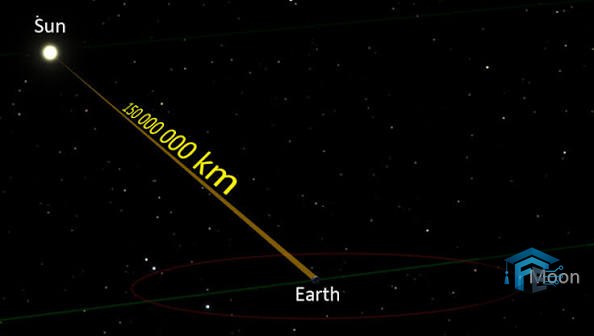

You might think the speed of light—about 300,000 kilometres per second—is just a really impressive speed that happens to be the fastest thing we've measured. But Einstein showed us something far stranger: the speed of light isn't a speed limit because light is special, but because of how time and space actually work. Light always travels at the same speed in a vacuum, regardless of who measures it or how fast they're moving. This constant speed led Einstein to realise that time and space aren't fixed—they stretch and compress depending on how fast you're moving.
Here's the mind-bending part: as an object accelerates closer to light speed, its mass effectively increases, requiring more and more energy to push it faster. At the same time, time slows down for that object relative to a stationary observer. To reach exactly the speed of light would require infinite energy and would cause time to stop completely. The speed of light is baked into the geometry of spacetime itself—it's the cosmic speed limit because accelerating anything massive beyond it would violate the laws of physics as we understand them.
This isn't just theoretical. GPS satellites have to account for the effects of relativity because they move fast enough that time runs slightly differently for them than for us on Earth. Particle accelerators like CERN's Large Hadron Collider routinely accelerate particles to 99.9999% of light speed, and experiments confirm they behave exactly as relativity predicts—they get harder to accelerate, and their time slows down. The speed of light remains unbreached, not because we haven't built a fast enough rocket yet, but because the universe's fundamental rules won't allow it.