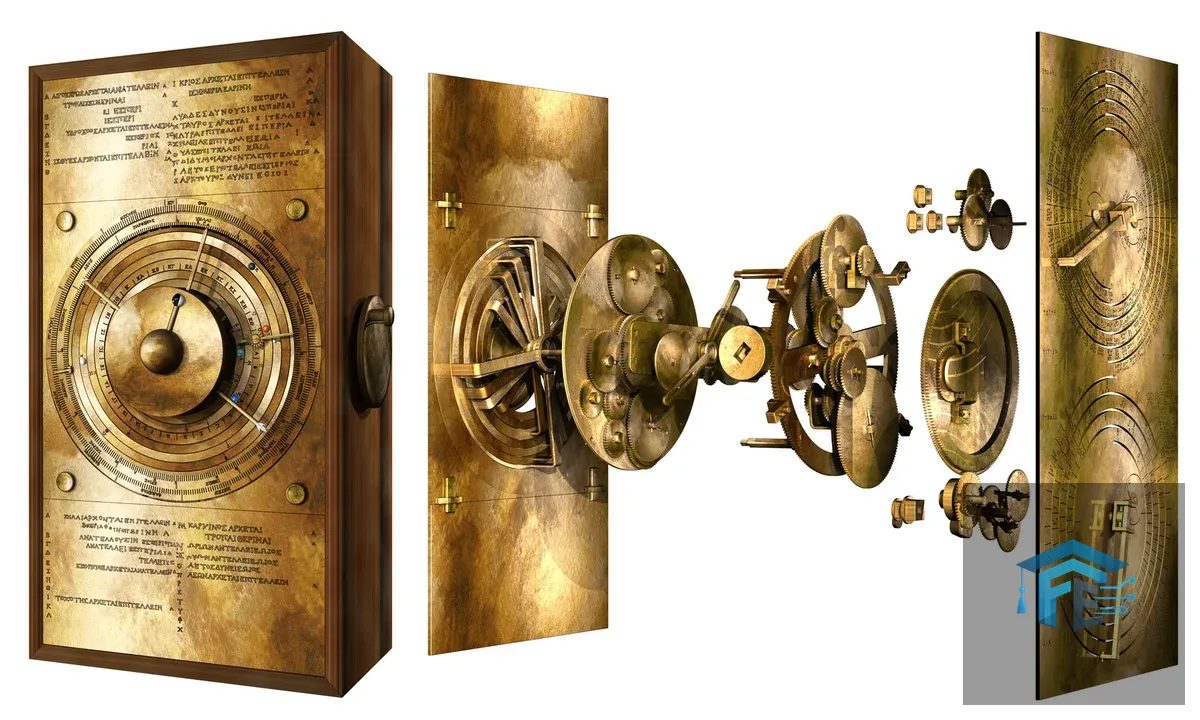
In 1901, Greek divers exploring a Roman shipwreck off the island of Antikythera discovered a corroded bronze device that would puzzle scientists for decades. This mechanism, dated to around 100 BCE, contained at least 30 interlocking gears and was used to predict the positions of planets and stars, as well as lunar eclipses. It's the oldest known example of an analog computer, and nothing remotely like it appeared again until medieval Islamic astrolabes and European mechanical clocks centuries later.
The device worked by turning a hand crank: as you rotated it, the gear system performed calculations through mechanical ratios. Different gear combinations encoded astronomical cycles—the 19-year Metonic cycle (which aligns lunar and solar calendars), the 18-year Saros cycle (which predicts eclipse patterns), and the 4-year Olympic cycle. By turning the input shaft, ancient astronomers could read out predicted positions on bronze dials without any written math or electronic assistance.
What makes the Antikythera mechanism even more remarkable is the precision of its engineering. The gears were cut by hand using techniques lost after the Roman period, and the tolerances were extraordinarily tight. Modern CT scanning (completed in the 2000s) revealed previously hidden inscriptions and showed that the internal complexity exceeded what researchers initially imagined—it likely had over 37 gears working in concert. This discovery fundamentally changed our understanding of ancient Greek mechanical ingenuity and mathematics.
The mechanism hints at a sophisticated technical tradition in the ancient world that we may have greatly underestimated. While we don't know exactly how many such devices existed or who designed them, the Antikythera mechanism proves that ancient engineers had solved problems of gear design, mechanical advantage, and astronomical prediction at a level of sophistication that wouldn't be matched again for more than a thousand years. It stands as proof that innovation and engineering excellence are timeless human drives.