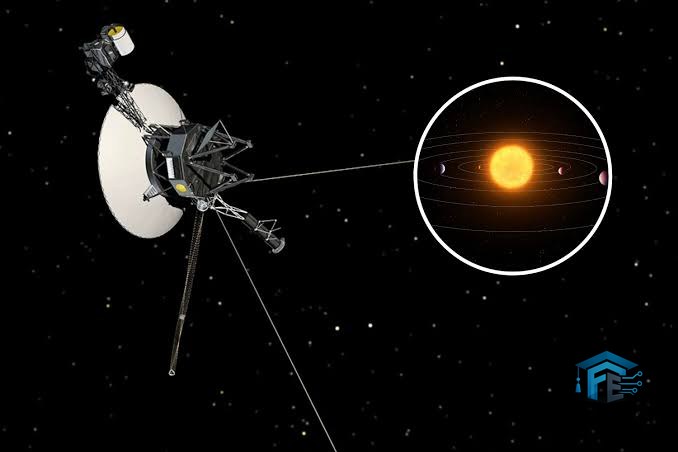
In August 2012, Voyager 1 crossed a boundary called the heliopause, marking the moment it left the Sun's direct influence and entered interstellar space. That makes it the first and only human-made object to ever achieve this milestone. What's even more remarkable? NASA engineers are still in contact with it today, receiving data transmitted across billions of kilometers through space.
The spacecraft was originally designed for a 5-year mission to study Jupiter and Saturn. But because of the unique geometry of the outer planets in the late 1970s—a rare alignment that happens only once every 176 years—Voyager 1 was given a 'Grand Tour' trajectory. After flying past Saturn in November 1980, it had enough speed and direction to keep going deeper into space indefinitely. The Sun's gravity weakens with distance, and once Voyager 1 was fast enough and far enough away, nothing could pull it back.
Today, Voyager 1 travels at roughly 17 kilometers per second relative to the Sun—fast enough that it would take it about 40,000 years to pass through the nearest star system, Proxima Centauri. Its instrument package runs on just 250 watts of power from its radioisotope generators (devices that convert heat from decaying plutonium into electricity), which is less power than a modern household lightbulb. Engineers have systematically shut down non-essential systems over the decades to keep the spacecraft operating, and at current power levels, Voyager 1 should remain contactable until around 2025.
Beyond being a technological achievement, Voyager 1 carries the 'Golden Record,' a phonograph record with sounds and images from Earth—greetings in 55 languages, music, and scientific data. It's humanity's message in a bottle, aimed at any intelligent beings who might find the spacecraft millions of years from now. That single object, launched before many engineers reading this were born, still represents our furthest reach into the cosmos.