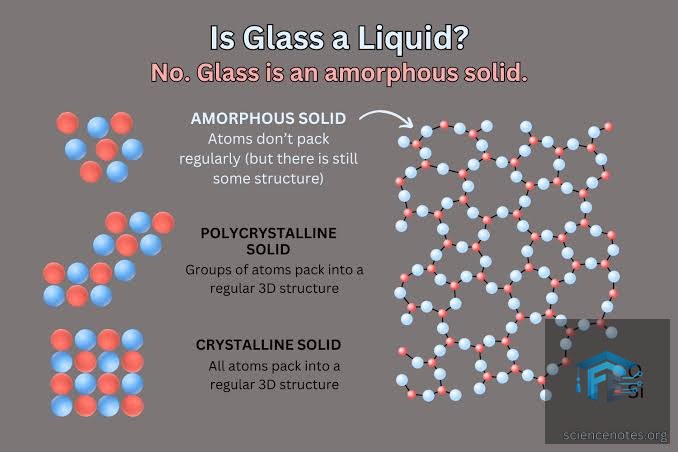
For decades, scientists and textbooks claimed that glass behaves like an extremely slow liquid, and that old cathedral windows are thicker at the bottom because the glass has 'flowed' downward over centuries. It sounds plausible, but it's wrong. Glass is definitively a solid. The real reason some antique windows are uneven? Medieval glassmakers simply couldn't produce perfectly uniform sheets, so they installed panes thicker-side-down for stability.
Here's what makes glass unusual: it's an 'amorphous solid,' meaning its atoms are arranged randomly rather than in the orderly crystalline pattern of typical solids like salt or diamond. This random structure gives glass some special properties—like transparency and brittleness—but it does not make it a liquid. Liquids flow freely and take the shape of their container; glass does not. If you leave a pane of glass on a table for a thousand years, it stays exactly the shape you left it.
The confusion arose because glass has no fixed melting point like crystalline materials do. Instead, it gradually softens as temperature increases, creating a 'glass transition.' Some early scientists misinterpreted this behavior as evidence of slow flow at room temperature. Modern physics and careful experiments have firmly established that glass has the rigidity and mechanical properties of a solid, not a liquid—no matter how old it is.
So the next time someone tells you that old glass windows prove glass flows like honey, you'll know the real science: glass is a solid with a fascinating atomic structure, and those uneven medieval panes are simply products of ancient manufacturing limitations, not millennia of molecular creep.