The Great Pyramid contains roughly 2.3 million stone blocks, many weighing 2.5 tonnes or more. Yet archaeologists have found copper tools, stone hammers, and wooden levers at pyramid construction sites—no advanced machinery. So how did workers cut and dress blocks so precisely that some joints fit together without mortar? The answer lies in understanding the properties of the stone itself and the ingenuity of Egyptian engineers.
Copper and bronze tools were remarkably effective because of clever technique, not material hardness. Egyptians used copper chisels struck with wooden or stone mallets, combined with abrasive powders like quartz sand. By pounding copper chisels repeatedly while grinding sand into the cut, they could slowly separate blocks from the quarry. This 'sand-assisted' cutting exploited a fundamental principle: the abrasive particles, harder than limestone, did much of the actual cutting work while the tool directed the force. Granite blocks required similar patience—sometimes taking weeks to cut a single piece.
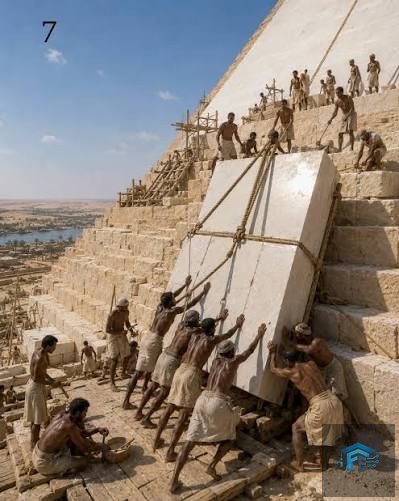
For moving these massive blocks, workers didn't rely on wheels (which were rare in Egypt during the Old Kingdom) but instead used sledges pulled across sand or wet ground, reducing friction significantly. Ramps, levers, rollers, and coordinated teams of dozens of workers moved and positioned each stone. Recent experiments by engineers have demonstrated that 50–100 workers using rope, wooden sledges, and water-lubricated sand can move a 2.5-tonne block with surprising efficiency. This isn't magic—it's physics and organisation.
The precision of the pyramid's blocks (often fitted to within millimetres) came from practice, careful planning, and copper tools in skilled hands. Egyptian quarrymen spent years mastering their craft, using simple methods repeated with discipline and accuracy. The Great Pyramid stands as proof that you don't need modern power tools to achieve remarkable engineering—you need patience, the right understanding of materials, and teams of people working together toward a single goal.