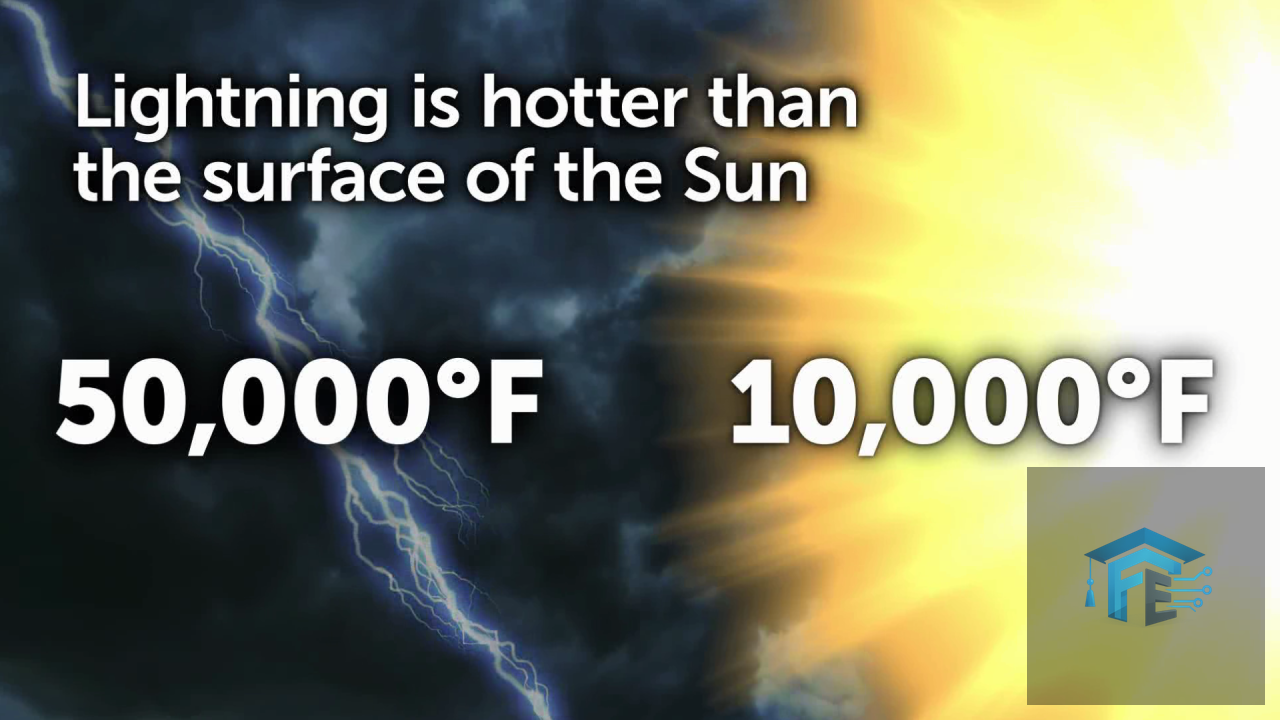
When you see lightning split the sky, that brilliant flash isn't just bright—it's scorching. The air channel created by a lightning strike heats to approximately 30,000 Kelvin (about 29,700°C or 53,500°F), while the sun's surface sits at a much cooler 5,800 Kelvin. This extreme temperature happens because of the enormous electrical energy concentrated in an incredibly thin path of air.
Here's why lightning achieves such intense heat so quickly: during a lightning strike, a massive electrical current—often 20,000 to 200,000 amperes—flows through a channel of air only a few centimetres wide. This current encounters resistance from the air molecules in its path. Electrical resistance converts that energy into heat almost instantly, following the principle that heat generated equals current squared times resistance (the famous P = I²R formula). The entire heating process takes just microseconds.
The sun, by comparison, generates its heat through nuclear fusion in its core, a process that's powerful but distributed across millions of tonnes of material. Lightning concentrates all its energy in a thread-thin channel of air, which is why the local temperature is so much higher—even though lightning releases far less total energy than the sun does continuously. When that superheated air expands explosively, it creates the shock wave we hear as thunder.
This is why lightning can cause such severe damage: the extreme heat can vaporize water inside living tissue, melt metals, and ignite fires. It's a dramatic reminder that temperature and total energy aren't the same thing—and that nature can create incredibly extreme conditions in spaces smaller than your finger.